
Skip to content

Patient Portal 

|

Text Us: 929-600-7724
MIND BODY Psychiatry Logo
  • About Us
    our team
    Our Team
    refer
    Refer a Patient
    career
    Careers
    fees
    Fees & Insurance
    drlewis
    DrLewis Functional Psychiatry Practice
  • Services
    hypnotherapy
    Hypnotherapy
    ketamine
    Ketamine Psychotherapy
    med management
    Medication Management
    nutrition
    Nutrition & Supplements
    psychiatric
    Psychiatric Evaluation & Treatment
    psychotherapy
    Psychotherapy
    service row1 (1)
    Child & Adolescent Psychiatry / Therapy
    service row1 (2)
    Adult Psychiatry and Therapy
    service row1 (3)
    Women’s Mental Health
    service row1 (4)
    LGBTQ+ Affirming Care
    service row1 (5)
    Executive & Professional Mental Health
    service row1 (6)
    Telehealth Psychiatry
    service row1 (7)
    Online Therapy
    service row1 (8)
    In-Person Psychiatry
    service row1 (9)
    Out-of-Network Psychiatrist
    Child Adolescent Psychiatry Therapy
    Couple’s Therapy
    Family Therapy
    Family Therapy
    Play Therapy
    Play Therapy
    Individual Therapy
    Individual Therapy
    Evidence Based Therapies
    Evidence-Based Therapies
    Integrative Psychotherapy
    Integrative Psychotherapy
    Integrative Mind Body Approaches
    Integrative & Mind-Body Approaches
    Mindfulness Based Therapy
    Mindfulness-Based Therapy
    Depression
    Depression & Treatment-Resistant Depression
    anxiery
    Anxiety / Health Anxiety / Panic Disorder
    adhd adults child
    ADHD (Adult & Child)
    ptsd menu
    PTSD & Trauma
    ocd menu
    OCD Treatment
    bipolar (1)
    Bipolar Disorder Treatment
    insomia
    Insomnia Treatment
    burnout (1)
    Burnout & Chronic Stress Treatment
    mental health support
    Grief Treatment
    post partum (1)
    Postpartum & Perinatal Mental Health Treatment
    therapy approaches (2)
    Therapy Approaches & Modalities
    cbt (1)
    Cognitive Behavioral Therapy (CBT)
    dbt (2)
    Dialectical Behavior Therapy (DBT)
    act (4)
    Acceptance and Commitment Therapy (ACT)
    psychodynamic (1)
    Psychodynamic Therapy
    emdr (1)
    EMDR Therapy
    last card (1)
    Internal Family Systems (IFS) Therapy
    trauma therapy (2)
    Exposure and Response Prevention (ERP)
    last card (3)
    Hypnotherapy
    trauma therapy (1)
    Trauma therapy
    emdr
    EMDR Therapy for Trauma
    trauma therapy (4)
    Trauma-Focused Cognitive Behavioral Therapy (TF-CBT)
    psych services
    Internal Family Systems (IFS) Therapy for Trauma
    Psychiatric Consultation (4)
    Psychedelic Integration Therapy
    somantic trauma (4)
    Somatic / Mind-Body Trauma Therapy
    somantic trauma (1)
    Psychiatry Services
    Psychiatric Consultation (4)
    Psychiatric Evaluation
    psych medication (1)
    Psychiatric Medication Management
    integrative psych (2)
    Integrative Psychiatry
    psych medication (2)
    Functional Psychiatry
    Psychedelic Integration (2)
    Metabolic Psychiatry
    Psychedelic Integration (4)
    Psychopharmacology
    Psychiatric Consultation (3)
    Psychiatric Consultation
    Psychiatric Consultation (1)
    Ketamine & Psychedelic Therapies
    ketamine (1)
    Ketamine-Assisted Psychotherapy
    ketamine infusion (2)
    Ketamine Infusion Therapy
    Psychedelic (1)
    Psychedelic Integration Therapy
    Psychedelic Integration (1)
    Treatment-Resistant Depression

    Book a Comprehensive ADHD Evaluation and Computerized Attention Assessment

  • Specialties
    addiction
    Addiction Treatment
    celebrating people
    ADHD Treatment
    anxiety
    Anxiety Treatment
    bipolar
    Bipolar Disorder Treatment
    smiling woman
    Body Image and Disordered Eating Treatment
    depression
    Depression Treatment
    grief
    Grief Therapy
    health anxiety
    Health Anxiety Treatment
    insomia
    Insomnia Treatment
    lgbt
    LGBTQ+ Affirming Therapy
    panic therapy
    Panic Therapy & Treatment
    relationship
    Relationship Therapy
    stress
    Stress Treatment
    trauma
    Trauma Therapy & Healing
    woman's health
    Women's Mental Health Treatment
  • Resources
    resources
    Resources
    faqs
    FAQs
    blog
    Blogs
    review
    Reviews
  • Contact Us
(212) 621-7770
Current patient
New Patient
MIND BODY Psychiatry Logo
Open menu
Close menu
  • About Us
    • Our Team
    • The Seven
    • Fees and Insurance
    • Careers
  • Services
    • ADHD Testing with Creyos
    • Health & Wellness Coaching
    • Hypnotherapy
    • Ketamine Therapy
    • Medication Management
    • Nutrition And Supliment
    • Psychiatric Evaluation and Treatment
    • Psychotherapy
    • Child & Adolescent Psychiatry / Therapy
    • Adult Psychiatry and Therapy
    • Women’s Mental Health
    • LGBTQ+ Affirming Care
    • Executive & Professional Mental Health
    • Telehealth Psychiatry
    • Online Therapy
    • In-Person Psychiatry
    • Out-of-Network Psychiatrist
    • ADHD Testing with Creyos
    • Couple’s Therapy
    • Family Therapy
    • Play Therapy
    • Individual Therapy
    • Evidence-Based Therapies
    • Integrative Psychotherapy
    • Integrative & Mind-Body Approaches
    • Mindfulness-Based Therapy
    • Depression & Treatment-Resistant Depression
    • Anxiety / Health Anxiety / Panic Disorder
    • ADHD (Adult & Child)
    • PTSD & Trauma
    • OCD Treatment
    • Bipolar Disorder Treatment
    • Insomnia Treatment
    • Burnout & Chronic Stress Treatment
    • Grief Treatment
    • Postpartum & Perinatal Mental Health Treatment
    • Therapy Approaches & Modalities
    • Cognitive Behavioral Therapy (CBT)
    • Dialectical Behavior Therapy (DBT)
    • Acceptance and Commitment Therapy (ACT)
    • Psychodynamic Therapy
    • EMDR Therapy
    • Internal Family Systems Therapy
    • Exposure and Response Prevention
    • Clinical Hypnotherapy
    • Trauma Therapy
    • EMDR Therapy for Trauma
    • Trauma-Focused Cognitive Behavioral Therapy
    • Internal Family Systems Therapy for Trauma
    • Psychedelic Integration Therapy
    • Somatic / Mind-Body Trauma Therapy
    • Psychiatric Services
    • Psychiatric Evaluation
    • Psychiatric Medication Management
    • Integrative Psychiatry
    • Functional Psychiatry
    • Metabolic Psychiatry
    • Psychopharmacology
    • Psychiatric Consultation
    • Ketamine & Psychedelic Therapies
    • Ketamine-Assisted Psychotherapy
    • Ketamine Infusion Therapy
    • Psychedelic Integration Therapy
    • Treatment-Resistant Depression
  • Specialties
    • Anxiety Treatment
    • ADHD Treatment
    • Trauma Therapy & Healing
    • Bipolar Disorder Treatment
    • Depression Treatment
    • Body Image and Disordered Eating Treatment
    • LGBTQ+ Affirming Therapy
    • Women’s Mental Health Treatment
    • Addiction Treatment
    • Grief Therapy
    • Panic Therapy & Treatment
    • Stress Treatment
    • Insomnia Treatment
    • Relationship Therapy
    • Health Anxiety Treatment
  • Resources
    • FAQs
    • Blogs
    • Reviews
  • Contact Us
  • About Us
    • Our Team
    • The Seven
    • Fees and Insurance
    • Careers
  • Services
    • ADHD Testing with Creyos
    • Health & Wellness Coaching
    • Hypnotherapy
    • Ketamine Therapy
    • Medication Management
    • Nutrition And Supliment
    • Psychiatric Evaluation and Treatment
    • Psychotherapy
    • Child & Adolescent Psychiatry / Therapy
    • Adult Psychiatry and Therapy
    • Women’s Mental Health
    • LGBTQ+ Affirming Care
    • Executive & Professional Mental Health
    • Telehealth Psychiatry
    • Online Therapy
    • In-Person Psychiatry
    • Out-of-Network Psychiatrist
    • ADHD Testing with Creyos
    • Couple’s Therapy
    • Family Therapy
    • Play Therapy
    • Individual Therapy
    • Evidence-Based Therapies
    • Integrative Psychotherapy
    • Integrative & Mind-Body Approaches
    • Mindfulness-Based Therapy
    • Depression & Treatment-Resistant Depression
    • Anxiety / Health Anxiety / Panic Disorder
    • ADHD (Adult & Child)
    • PTSD & Trauma
    • OCD Treatment
    • Bipolar Disorder Treatment
    • Insomnia Treatment
    • Burnout & Chronic Stress Treatment
    • Grief Treatment
    • Postpartum & Perinatal Mental Health Treatment
    • Therapy Approaches & Modalities
    • Cognitive Behavioral Therapy (CBT)
    • Dialectical Behavior Therapy (DBT)
    • Acceptance and Commitment Therapy (ACT)
    • Psychodynamic Therapy
    • EMDR Therapy
    • Internal Family Systems Therapy
    • Exposure and Response Prevention
    • Clinical Hypnotherapy
    • Trauma Therapy
    • EMDR Therapy for Trauma
    • Trauma-Focused Cognitive Behavioral Therapy
    • Internal Family Systems Therapy for Trauma
    • Psychedelic Integration Therapy
    • Somatic / Mind-Body Trauma Therapy
    • Psychiatric Services
    • Psychiatric Evaluation
    • Psychiatric Medication Management
    • Integrative Psychiatry
    • Functional Psychiatry
    • Metabolic Psychiatry
    • Psychopharmacology
    • Psychiatric Consultation
    • Ketamine & Psychedelic Therapies
    • Ketamine-Assisted Psychotherapy
    • Ketamine Infusion Therapy
    • Psychedelic Integration Therapy
    • Treatment-Resistant Depression
  • Specialties
    • Anxiety Treatment
    • ADHD Treatment
    • Trauma Therapy & Healing
    • Bipolar Disorder Treatment
    • Depression Treatment
    • Body Image and Disordered Eating Treatment
    • LGBTQ+ Affirming Therapy
    • Women’s Mental Health Treatment
    • Addiction Treatment
    • Grief Therapy
    • Panic Therapy & Treatment
    • Stress Treatment
    • Insomnia Treatment
    • Relationship Therapy
    • Health Anxiety Treatment
  • Resources
    • FAQs
    • Blogs
    • Reviews
  • Contact Us
Integrative psychiatry

Integrative Treatment Options for Seasonal Affective Disorder (SAD)

November 12, 2019

10 Min Read

Dr. Bliss Lewis, MD
Written by: Dr. Lewis

Format

Topics

Home / Blogs / Integrative Treatment Options for Seasonal Affective Disorder (SAD)

Cooler temperatures can drain you of your energy and affect your mood, particularly in the fall and winter months following daylight savings time. Many interpret these feelings as a case of the “winter blues” but if they persist, the feelings could be related to a clinical condition called seasonal affective disorder (SAD).

SEASONAL AFFECTIVE DISORDER- AN OVERVIEW

According to the National Institute of Mental Health, seasonal affective disorder is a type of depression that comes and goes with the seasons. It typically starts in the late fall and early winter and resolves during the spring and summer. While depressive episodes linked to the summer can still occur, they are much less common than winter episodes of SAD.

SIGNS, SYMPTOMS, AND DIAGNOSIS

SAD is not classified as its own separate disorder, but rather a subtype of major depression marked by a recurring seasonal pattern. It shares many of the same symptoms as major depression but is distinguished by other, season – specific symptoms.

View fullsize
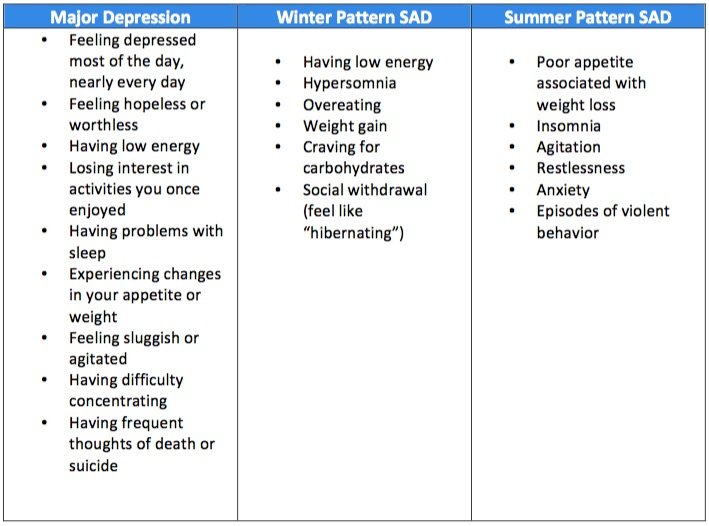
Depression Types and Corresponding Symptoms

Those who meet the full criteria for major depression coinciding with specific seasons (appearing in the winter or summer months) for at least two years may be diagnosed with seasonal affective disorder. Seasonal depressions must be more frequent than any non-seasonal depressions.

There are several attributes that may increase one’s risk of developing seasonal affective disorder:

  • Gender: Women are diagnosed with SAD four times more often than men.

  • Distance from the equator: Those who live further north or south of the equator may have an increased risk.

  • Family history: This includes those with a family history of other types of depression.

  • Having depression or bipolar disorder: If you have already been diagnosed with depression or bipolar disorder, your symptoms of depression may worsen with the seasons. However, it will only be diagnosed as seasonal affective disorder if your seasonal depressions are the most common.

  • Age: Younger adults are at higher risk for SAD than older adults. Lower rates have also been reported in children and teens.

CAUSES AND TREATMENT OPTIONS

The causes of seasonal affective disorder are currently unknown, however, research has identified several biological traits which are helping doctors to gain a better understanding of the disorder. People with SAD may:

  • Have difficulty regulating serotonin, one of the key neurotransmitters involved in mood.

  • Overproduce melatonin, the hormone which regulates sleep.

  • Underproduce Vitamin D, which plays an important role in a multitude of biochemical pathways in the body.

There are four main treatment options available for seasonal affective disorder:

  • Medication

  • Light Therapy

  • Psychotherapy

  • Vitamin D

MEDICATION

Selective serotonin reuptake inhibitors (or SSRIs) are the type of medications most commonly used to treat depression and anxiety. These medications work to regulate the level of serotonin in the brain–the key neurotransmitter that helps regulate mood, sleep, appetite and digestion.

Common SSRIs include Zoloft (sertraline), Prozac (fluoxetine), Celexa (citalopram), Lexapro (escitalopram) and Paxil (paroxetine). In 2006, an antidepressant called bupropion (Wellbutrin) was also approved for use by the FDA to treat seasonal affective disorder.

Advances in medical research have led to the refinement of SSRIs, improving their ability to target specific subtypes of serotonin receptors. This has resulted in a reduction of side effects, though as with other medications, side effects are still possible.

The benefits of SSRIs are not immediately felt as it may take two to four weeks before changes in neurotransmitter receptors takes place. While all of the medications listed can be considered for treatment of SAD.  Bupropion is the only FDA approved preventative medication for seasonal affective disorder. Bupropion can be started in September to November and continued for four to six months to prevent SAD.

VITAMIN D SUPPLEMENTATION

Scientists believe that one of the root causes of seasonal affective disorder is vitamin D deficiency (VDD). Worldwide, it is estimated that one billion people have VDD, and this is very concerning because VDD is increasingly being implicated in diseases like type II diabetes, colon cancer, and autoimmune disease. Those who are vitamin D deficient may also be twice as likely to be diagnosed with schizophrenia.

Unlike other vitamins, vitamin D functions like a hormone in our bodies and plays a significant role in serotonin activity. As many of you are already aware, serotonin is the key neurotransmitter involved with mood, sleep, appetite and digestion. It seems reasonable then that a deficiency in vitamin D could lead to dysregulation of these processes.

Vitamin D is often called the “sunshine vitamin” because our bodies require the UV B radiation that the sun produces in order to make it. 7-dehydrocholesterol is a precursor to cholesterol found in the skin that turns into vitamin D3 upon absorbing UV B radiation (the body is magical like that!). Without UV B radiation, our bodies can’t make vitamin D3 it needs to function optimally.

a blue sky with clouds

Sun induced vitamin D production varies based on the season, distance from equator, air quality, and time spent outdoors. In the winter, vitamin D levels may be suboptimal as a result of a shorter exposure time to sunlight, and interestingly, people who live further from the equator in either direction (north or south) are at an increased risk of developing seasonal affective disorder.

A 2013 meta-analysis found that low vitamin D levels were associated with depression. There has been less research focused on seasonal affective disorder in particular, but one randomized controlled trial comparing vitamin D supplementation to light therapy had promising results. It showed that after one month of vitamin D supplementation, participants saw significant improvement across all items on the mood questionnaire used for the study. The outcomes correlated with a rise in vitamin D blood levels of 74%.

IS VITAMIN D SUPPLEMENTATION RIGHT FOR YOU?

Optimal vitamin D levels are considered between 33 and 80 ng/mL. Those with less than 33 ng/mL are considered to be insufficient in D, less than 20 ng/mL is deficient and, and less than 10 ng/mL severely deficient.

Your body naturally makes vitamin D from cholesterol when your skin is exposed to sunlight. While certain foods such as fatty fish and fortified dairy products are known to contain some vitamin D, it is difficult to get the recommended daily intake from diet alone. Officially the recommended daily intake for the average adult ranges from 400-800 IU (or 10-20 mcg), but that may not be enough to maintain normal levels of vitamin D. Based on the level of vitamin D in your blood, the recommended daily intake may be even higher (1,000-2,000 IU), and if you are deficient you may need even more than that to increase your vitamin D levels.

There are several ways to help increase your levels of vitamin D including diet, safe sun exposure, and supplements. However, working to increase your level is best done at the recommendation and under the supervision of a licensed medical professional so that you can monitor blood levels of vitamin D to achieve levels in the optimal range.  Since vitamin D is fat soluble it is possible to overdose on vitamin D, so it is important to not overdo supplementation.

LIGHT THERAPY

For those who are averse to taking medications or supplements, or who are looking for a complementary treatment, light therapy may be a great option.

Light therapy involves sitting close to a light box emitting bright, artificial light for at least 30 minutes per day, preferably in the morning soon after waking up. This kind of therapy has been scientifically proven to be as effective as antidepressant medications in reducing the winter depressive symptoms of seasonal affective disorder (SAD). Light boxes for treatment of SAD would ideally provide 10,000 lux (the lux is the unit of measurement for light). For comparison, light intensity on a sunny day is 50,000 lux.

a light bulb in front of a pink background

In one study, 332 patients from 14 research centers were studied over a period of 5 years. Overall, those who were exposed to 2500-lux intensity light for at least two hours each day for a period of one week saw a depression score reduction of 50% or more on the Hamilton Depression Rating Scale (HAM-D).

Though proven to be effective, it’s important to note that the National Institute of Mental Health reports that nearly half of all people with seasonal affective disorder don’t see improvement from light therapy alone. In these cases, it is best used as a supplement to other treatment methods.

WHAT KIND OF LIGHT DO I USE?

While there have been many products developed over the last several decades corresponding to advances in research on SAD, there is more to light therapy than simply switching out the bulbs in your home or office.

Research has shown that human circadian rhythms are more sensitive to short wavelength light. As a result, light treatment devices that use efficient light-emitting diodes (LEDs), whose output is relatively concentrated in short wavelengths, may help increase the effectiveness of light therapy. However, some wavelengths of light can be hazardous to your eyes or skin, so it’s important to consult with a healthcare professional before beginning light therapy.  There are a few reputable companies making light boxes for the treatment of SAD that are easily accessible on Amazon and other sources.

HOW MUCH LIGHT EXPOSURE IS ENOUGH?

The right “dose” of light exposure is dependent on a variety of factors including an individuals needs, lifestyle, time of day, the distance between the user and the device, and the intensity and wavelengths of light that are emitted from the device. Too much light can have a similar effect as consuming too much caffeine and leave a user feeling “wired.” Not enough exposure, and you may feel as though the treatment is ineffective.

It’s important to consult with a healthcare professional that is experienced in administering and monitoring the effects of light therapy. They can help recommend an appropriate light type and illumination “dose” to offset the symptoms of seasonal affective disorder, particularly when cold weather or fewer daylight hours make exposure to outdoor sunlight difficult.

Keep in mind, light therapy requires consistent use over time. It is a commitment that often involves a minimum of 30-60 minutes per day until the season changes and your exposure to natural sunlight increases. If you get a light box which provides 10,000 lux then the daily dose may be 30 min a day if you sit with your face within 12 inches of the light or 60 min a day if you sit with your face 18 inches from the light.  Ideally you use your light first thing in the morning. For bipolar depression the recommendations are somewhat different and more caution is needed to avoid triggering a hypomania or a mania and mid-day timing of light therapy around 2pm may be better.

WHEN TO SEEK HELP

If you are experiencing the symptoms of major depression and/or the season-specific depression symptoms, it is important to consult with a medical professional. If you are in Brooklyn, our care team can work with you to find the most effective treatment option for your individual needs. This may include supplements or a combination of supplements, psychotherapy, light therapy, and medication. Contact us at (212) 621-7770 and our intake coordinator will work with you to match you with the right clinician for your needs.

Book a Comprehensive Assessment

Get Started

Ready to begin your healing journey?

Schedule a Consultation
Dr. Lewis

About Dr. Lewis

Dr. Bliss Lewis, MD

Whatever you’re facing, you don’t have to face it alone. Our compassionate team is here to help.

Start Your Journey Today

Related Topics

  • Why Traditional Care Sometimes Falls Short
  • Functional Psychiatry Explained
  • Sleep, Nutrition, and Emotional Regulation
  • Why Mental Health Isn’t Just Brain Chemistry
  • Why You Feel Off: How Lifestyle Affects Mental Health
Beata "Bliss" Lewis, M.D.
First Co-Author Image

Author

Beata "Bliss" Lewis, M.D.

Owner

I'm Dr. Beata "Bliss" Lewis, a Harvard-trained psychiatrist specializing in integrative approaches to mental health. I blend traditional psychiatry with functional medicine, incorporating psychotherapy, medications, supplements, functional lab testing, mind-body techniques, and lifestyle interventions to treat the whole person. My training includes adult psychiatry at Columbia and child psychiatry at NYU Child Study Center, with advanced certifications in functional and integrative medicine. I specialize in anxiety, depression, ADHD, and trauma. As a mother of twin elementary school girls, I stay connected to the everyday realities families face.

Reviewed By:

Reviewed By Image

Hayden Reed

Administrative Staff

Ready to begin your healing journey?

Get started with Mind Body Psychiatry

Schedule a Consultation
MIND BODY Psychiatry LOGO White
Facebook Youtube Instagram Mental Health Support tiktok

Join our Newsletter

Join our email list. Subscribers receive exclusive content featuring my best wisdom, resources, and advice to enhance your well-being.


Specialties

  • ADHD
  • Anxiety
  • Bipolar Disorder
  • Depression
  • Grief Therapy
  • Trauma
  • Eating & Body Concerns
  • Relationship Concerns
  • Insomnia Treatment
  • Stress Treatment
  • Women’s Health
  • LGBTQ+ Affirming Therapy
  • ADHD
  • Anxiety
  • Bipolar Disorder
  • Depression
  • Grief Therapy
  • Trauma
  • Eating & Body Concerns
  • Relationship Concerns
  • Insomnia Treatment
  • Stress Treatment
  • Women’s Health
  • LGBTQ+ Affirming Therapy

Browse

  • Home
  • About Us
  • Services
  • Resources
  • Reviews
  • Contact Us
  • Home
  • About Us
  • Services
  • Resources
  • Reviews
  • Contact Us

Contact Info

  • Email: info@mindbody7.com
  • Text: (929) 600-7724
  • Call: (212) 621-7770
  • Brooklyn Office:
    200 Prospect Park West Brooklyn, NY 11215
castle connoly

©2025 Mind Body Psychiatry PC | All Rights Reserved.

  • Terms of Service
  • Privacy Policy
  • Terms of Service
  • Privacy Policy
ADHD Evaluation Form

Creyos+ ADHD Evaluation with 1 hour with a Licensed Clinical Psychologist

Creyos Assessment Form

Computerized Attention and Cognitive Function Assessment

Schedule a Consultation Fees & Insurance

Schedule Your Consultation

Complete the form below and you’ll be redirected to our secure scheduling portal.

We use cookies to ensure that we give you the best experience on our website. If you continue to use this site we will assume that you are happy with it.